|


SHORT SYNOPSIS
A controversial documentary about four gay men, who are living on the
countryside of Swabia (a rural area in the south west of Germany) far
off big cities. Being alone as Gays among a entirely heterosexual
environment, they still try to live a rich and happy life.
Interview with Jochen Hick
(english)
Synopsis in french (en
francais)
AG-Dok
Documentary Association's page for TALK STRAIGHT (external link)
Download
official Berlin film fest catalogue information about TALK STRAIGHT
(ext. link 520 kB PDF file)
Press
reviews (English & German language)
Download Synospsis
and technical information (English) as Word file
SYNOSPIS
In big cities discrimination against homosexuality and gay way of life
is not a big issue anymore. Gay mayors and football club association
presidents are no longer colourful exceptions to the rule, rather they
have become an expression of normality. In rural areas, however, the
definition of what is normal is quite different. Out here, normal means
a husband, wife and children "the nuclear family". In the country,
expressions such as "proofter" are still common parlance and mothers
are ashamed if their sons fail to bring home a girlfriend.
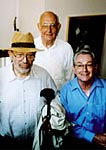
Hartmut, Richard, Stefan and Uwe are all gay men who
live in the country. They punctuate their rural existence with brief
but regular sojourns in Berlin, Zürich or Thailand. These four men have
learned to live with the fact, that their lifestyle is met with a
volley of abuse from their heterosexual friends and acquaintances in
the church choir and at the local pub.
Jochen Hick's film provides an insight into a largely
unknown world. The audience follows the lives of the protagonists via
the comments of their heterosexual environment. Expressed in the local
dialect, the often comical and regular surprising comments on
homosexuality demonstrate just how deep the gulf is between what is
supposedly normal and what comprises a deviation from the norm. The
film provides a bitterly comical portrait of a heterosexual perspective
on gay men in Germany's country towns.
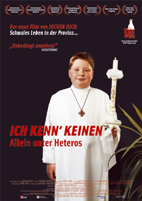
German poster for theatrical release.
SYNOPSIS (en francais)
Dans les grandes villes, la discrimination de l’homosexualité et des
mœurs gays n’est plus à l’ordre du jour. Un maire ou un président de
club sportif homosexuel ne constitue plus une exception, c’est
l’expression de la normalité. A la campagne, la normalité se définit
autrement. Etre normal, ici, c’est le mari, la femm et des enfants – la
petite famille. En provence le « sale pédé » est encore désigné
publiquement par ce vocable. Les mères ont honte si les fils ne ramene
pas de petite ami à la maison.
Hartmut, Richard, Stefan et Uwe sont des homosexuels qui
vivent à la campagne. En soffrant de temps en temps une petite évasion
á Berlin et Zurich ou en Thailande. Ils ont tous les quatre appris à
supporter tail que leur style de vie soit l’objet de commentaires peu
amènes de la part de leurs connaissances et amis hétérosexuels que ce
soit à la chorale de la paroisse ou à la brasserie du village.
Le film de Jochen Hick donne un apercu de leur
quotidien, méconnue de la plupart des gens. Le public suit la vie des
protagonistes à travers des commentaires de leur entourage
hétérosexuel. L’expressions de ces commentaires bigarrés, souvert
grotesques et toujours surprenants sur l’homosexualité montre le fosse
profond qui existe encore entre « normalité » et altérité. Une vision
hétérosexuelle amèrement comique des homosexuels masculins dans
l’Allemagne profonde.
INTERVIEW with Jochen Hick by Bruno Saito (Folha de
Sao Paulo, S.P., Brazil)
Q: How did you get the idea to make TALK
STRAIGHT?
When I visited my parents in Stuttgart (the home town of Porsche,
Mercedes and Bosch), while going out, I met a lot of gay people who
drove more than 3 hours (ony way) from their little rural villages,
just to be able to drink a beer in a gay bar of Stuttgart. I wanted to
know, how they organize their gay life back where they come from. The
south-west of Germany is a quite conservative are where the
christian-democrats rule and both protestant and catholic church still
have quite of an influence on daily life.
Q: What was your idea for the film?
I have always done films in big gay metropoles, like New York, San
Francisco and New York, where gay people have their own society, almost
excluding any heterosexual moment. Germany is very proud about their
partnership laws and their openly gay mayor of Berlin. But what does
this really change in the life of gay men and women, who live in little
villages, where they are the only known or unrevealed gay citizen.
Q: How did you get in contact with your
protagonists?
Always by referral, it took a long while, almost two years until we
have found all of them. It was sometimes even more difficult to make
their friends and family members join the film as well, since we did
want to show all persons in their surrounding.
Q: In big cities, being gay doesn’t seem to
be a big thing anymore. Why do you think your protagonists still have
to fight so much against prejudices?
I think we are not living in a such an progressive society as we
sometime tend to think. The liberalism for sexuel diversities we are
living in right now might ot be as profound. We met heterosexuals who
told us that they already seem to be a minority, since the tv-channels
would be full of gays and lesbians, which is definitely not true for
Germany.
Q: Do you think there is a connection
between how far a society is developped and educated and how tolerant
it is against gays and lesbians?
I have to say that the area we have been filming in is not at all
underdevelopped. It’s the region with the highest quantity of
universities per head in Germany and also very wealthy. This – for me –
made it even more astonishing. But by the way, you would not need to
spend a lot of time to find very antigay or ignorant voices in Berlin
or Sao Paulo. Just that there it’s a little bit less political correct
to say it upfront.
Q: Why does homosexuality seem so
threatening especially for people from small villages?
No idea why they react like that. Maybe because they think in their
village every sign of being beyond the “normal” is the beginning of
decadence and decay. But also because the mechanisms of social control
are much more intact than in bigger cities.
Q: Have you been in contact with your
protagonists after the filming?
Yes sure, I am very much in contact with all of them. They seem very
happy with it an have attended personally as many festival screenings
as possibly. In January the films starts theatrically in Germany and
they are already looking forward to it. This is a much different
approach than at the beginning of the shoot, when they were more
reluctant, if not even a bit anxoius about the project.
Q: What do you consider as “normal” or
“abnormal”?
“Normal” still tends to be what the majority does, I think this will
never change profoundly. But it can become a more normal situation to
accept the “non mainstream”.
Q: What do you think might be the region for
people in rural areas to first hide and finally come out?
They think they will never be happy if they hide. One person in the
film, Hartmut, he only came out when he got his positive HIV test and
the reactions of his surrounding where by far not as horrible as he
expected them to be. He regrets a lot for not having it done decades
earlier, because hiding his homosexuality really messed up his life.
Q: What is your conclusion after having
completed that film?
Never trust the liberalism which media tries to make us believe. The
freedom of choices is still not existent for many gay and lesbians. I
was surprised how much the life situation of the portrayed persons
could be unterstood in foreign countries, even on screenings in South
America like in Bogotá. And I am of course happy that the film won the
Teddy Award for the Best Documentary at the Berlin Film Festival this
year.
|


